Bilingual Arabic and English websites
Two languages, each one treated as the main one.
Many Arabic versions are an afterthought: a translation plugin, a flipped stylesheet and a menu that still reads left to right. Your Arabic-speaking customers notice at once, and so do search engines. I build both languages into the site from the start, so each reads naturally and can be found on its own.
A bilingual website serves complete Arabic and English versions, each on its own URL, with right-to-left layout, Arabic typography, and hreflang tags that tell search engines which version to show. I engineer the right-to-left layout and the multilingual SEO; the Arabic text is written or reviewed by a native speaker before launch. This website is a working example, published in both languages.
Who this is for
- Consumer-facing UAE businesses adding Arabic to an English site
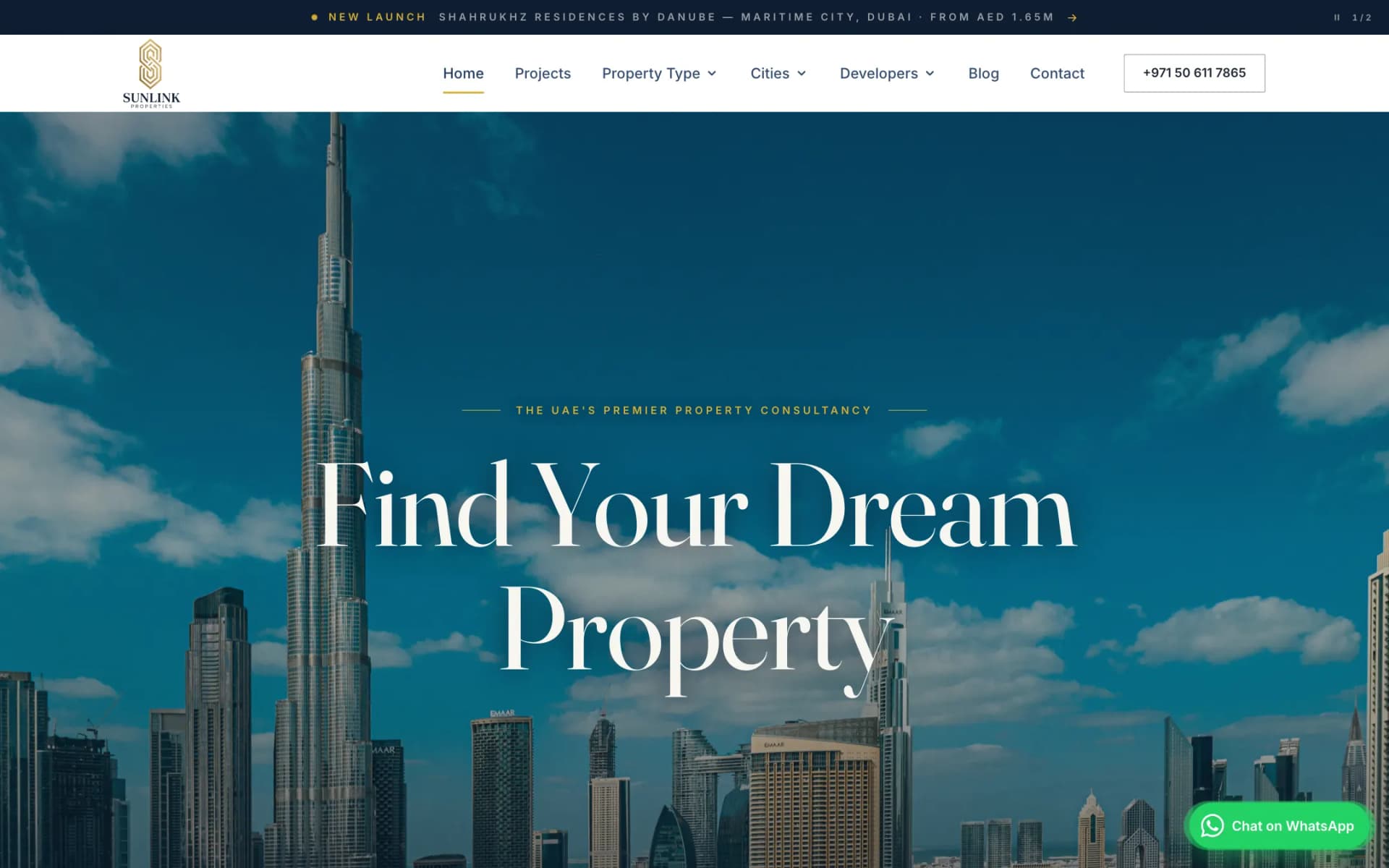
- Real estate developers and brokers marketing to Arabic- and English-speaking buyers
- Clinics, restaurants and retailers whose customers expect Arabic
- Companies whose current Arabic pages are machine-translated or broken on mobile
Problems this solves
- The Arabic pages look mirrored but feel wrong.
- Right-to-left is more than reversing the layout. Navigation, arrows, sliders and form fields mirror properly, while logos, media controls, phone numbers and prices stay left-to-right where they should.
- Arabic text is hard to read.
- Arabic needs its own typeface, sizes and line spacing, chosen to sit comfortably beside the English font rather than a fallback the browser picks.
- Google shows the English page to Arabic searchers.
- Each language gets its own URL with matching hreflang tags in both directions and its own titles and descriptions. No automatic redirects by location, which hide pages from search engines.
- Nobody owns the translation.
- We agree a workflow before the build: your team or a professional translator writes the Arabic, a native speaker reviews it, and pages go live only when both versions are approved.
What’s included
- Right-to-left engineering
- Layouts built with direction-aware CSS, mirrored icons and animation, and isolated mixed-direction text so phone numbers, AED prices and product names display correctly inside Arabic sentences.
- Arabic typography
- An Arabic typeface paired with your English one, with sizes, weights and spacing set for Arabic, loaded efficiently so pages stay fast.
- Separate SEO for each language
- Per-language URLs, canonical tags, hreflang with an x-default, Arabic titles and descriptions, and structured data marked with the right language.
- Translation workflow
- A shared content file or CMS with both languages side by side, native-speaker review built into sign-off, and a rule that unreviewed pages are not indexed.
- Bilingual forms and messages
- Arabic labels, error messages and success messages, phone fields that accept UAE and international formats, and WhatsApp links with an Arabic pre-filled message.
- Language switcher done right
- A plain link to the same page in the other language, labelled in that language, that never forces a visitor into one version.
How it works
1Content audit
Which pages need both languages at launch, which can follow, and who writes and reviews the Arabic.
2Bilingual design
Key pages designed in both directions at once, so the Arabic layout is decided, not improvised.
3Build
Both versions built on a preview link, with right-to-left checked on real phones.
4Review and launch
Native review, hreflang and canonical checks, then both languages go live together.
Related work
Questions UAE business owners ask
Do you write the Arabic copy?
No. I'm not a native Arabic writer, so I won't pretend to be. The Arabic is written or reviewed by a native speaker (your team or a professional translator) and I make sure it displays and indexes correctly.
Is Arabic legally required on a UAE website?
No general rule was found that requires every business website to be in Arabic, but UAE consumer protection rules require Arabic for much consumer-facing information and advertising. If you sell to consumers, check with your adviser; bilingual is the safe default.
Can't we just use automatic translation?
Machine translation is a useful draft, not a finished page. Unreviewed translations read badly to native speakers, and thin auto-generated pages can fall foul of Google's spam policies.
Should Arabic pages have Arabic URLs?
Usually not. Google detects language from the visible content, not the URL, and Arabic URLs turn into long encoded strings when shared on WhatsApp or email. I keep the same slugs under an /ar path.
Can you add Arabic to our existing site?
Often, yes. It depends on how the site was built. I start with a review of how far the current code can handle right-to-left before quoting.
Your business could be the next tile in the wall.
This space is kept for the next project.
Tell me what you need
Send a few lines about your business and the project. I'll reply with questions or a time for a video call. Prefer messaging? WhatsApp works too.